Booking choice: The minibus chase with photos, about 6 hours. Book this Tour details
The 2026-27 aurora season in Tromsø is already running. The first tours went out in early September, guests were posting green and pink skies within weeks, and the long nights are only getting longer from here.
This post covers what is different this winter: where solar cycle 25 stands, which dates matter for planning (moon, polar night, clock change, equinox), and how to spread your chances across a trip.
The quick answer
Solar cycle 25 peaked around October 2024 and is now in its declining phase, which still produces strong storms. Tromsø's season runs from late August to early April, and most tours run from early September. The darkest stretch is the polar night, 27 November 2026 to 15 January 2027. New moons fall on 9 November, 9 December, 7 January, 6 February and 8 March. Cloud, not the Sun, decides most nights, so plan three or more evenings.
Is 2026-27 a good season for the northern lights in Tromsø?
Yes. Solar activity is falling from the 2024 peak, but the declining phase still brings strong storms, and Tromsø sits under the auroral oval where even quiet nights can show the lights.
Solar maximum for cycle 25 very likely came in October 2024, based on the smoothed sunspot count. Space.com puts all of 2025 in the declining phase and expects the trend to continue through 2026. Fewer sunspots, fewer flares. Not zero.
The UK Met Office said in January 2026 that the declining phase "can often bring strong events", and history backs that up: cycle 23 produced the Halloween storms of 2003, two years after its peak, and cycle 24 fired its two largest flares in September 2017, more than three years after its peak. This cycle has kept going too. A G4 (severe) storm hit on 11 November 2025, and another G4 arrived on 20 January 2026 after an X-class flare two days earlier.
For Tromsø, all of this matters less than you would think. Visit Tromsø notes that high solar activity has "little impact on the activity directly below the Northern Lights oval". Big storms make headlines further south. Up here, a clear sky on an ordinary night is often enough.
When does the 2026-27 northern lights season start and end?
The sky is dark enough from late August, tours run from early September, and the season fades out in early April as the nights get too bright.
Visit Tromsø gives the window as late August to early April, "whenever the sky is dark and sufficiently clear", with most northern lights activities starting in early September. That matches the sky. In late August the night is only a short stretch of twilight; by mid September Tromsø gets proper darkness again, and from then on the dark hours grow every week until the solstice.
At the other end, real darkness at night runs out in the first week or so of April 2027. After that, the sky never gets darker than twilight, and by late May the midnight sun takes over. The times below are approximate dark-sky windows for Tromsø, worked out from the Sun's position. Use them for planning, not to the minute.
| Month | Dark sky, roughly | What to expect |
|---|---|---|
| Mid September | 21:45 to 03:30 | Short nights, no snow, aurora over open water |
| Mid October | 19:15 to 05:45 | Long nights, often wet and cloudy |
| Mid November | 16:30 to 06:30 | Dark early, first snow arriving |
| Mid December | 15:40 to 07:40 | Polar night, the most darkness |
| Mid January | 16:20 to 07:25 | Still very dark, colder, drier inland |
| Mid February | 18:00 to 05:50 | Daylight back, snow and dark nights |
| Mid March | 19:55 to 03:50 | Equinox period, shorter nights |
| Early April | 22:30 to 03:00 | Last dark nights of the season |
What is different about this winter compared with 2024-25?
Fewer headline storms than at the peak, more storms from long-lived holes in the Sun's atmosphere that can come back about every 27 days, and the same Tromsø weather.
At solar maximum the big events come from sunspot groups and their flares. On the way down, a lot of the activity comes from coronal holes: open patches in the Sun's atmosphere that send out fast solar wind. They can last several rotations, and the Sun turns once about every 27 days as seen from Earth, so a disturbed night can repeat roughly four weeks later. NOAA publishes a 27-day outlook of expected geomagnetic activity, which is a fair first look when you are picking dates.
The equinoxes help too. Geomagnetic activity tends to run higher around late September and late March, an effect explained in plain language by EarthSky. The March 2027 equinox is on 20 March, which makes mid to late March a good bet if you prefer milder days.
One practical change: Norway turns the clocks back on 25 October 2026 and forward on 28 March 2027. Check your tour's start time around those dates: after 25 October the dark comes an hour earlier on the clock, and after 28 March an hour later.
Which dates should you know for the 2026-27 aurora season?
The new moons, the polar night and the equinox. A dark, moonless sky makes faint aurora easier to see; a full moon lights the landscape but washes out weak displays.
The moon does not stop the aurora. A bright display shines through moonlight easily, and plenty of photographers like the lit snow and mountains. But for faint arcs, the week around a new moon gives the darkest sky. Moon dates below are from calendar.center (a day either side is close enough for planning), and the sun dates are for Tromsø centre.
| Date | What happens | Why it matters |
|---|---|---|
| 25 October 2026 | Clocks go back one hour | Darkness starts an hour earlier |
| 9 November 2026 | New moon | Dark skies for the week around it |
| 24 November 2026 | Full moon | Bright snow, faint aurora harder to see |
| 26 November 2026 | Last sunrise until January | Polar night begins the next day |
| 9 December 2026 | New moon | Darkest sky of the polar night |
| 24 December 2026 | Full moon | Christmas Eve under a bright moon |
| 7 January 2027 | New moon | Dark sky, colder and often clearer inland |
| 16 January 2027 | First sunrise above a flat horizon | Light returning fast |
| 6 February 2027 | New moon | Good mix of daylight and dark nights |
| 8 March 2027 | New moon | Run-up to the equinox |
| 20 March 2027 | Spring equinox | Higher odds of geomagnetic activity |
| Early April 2027 | Last dark nights | Season winds down |
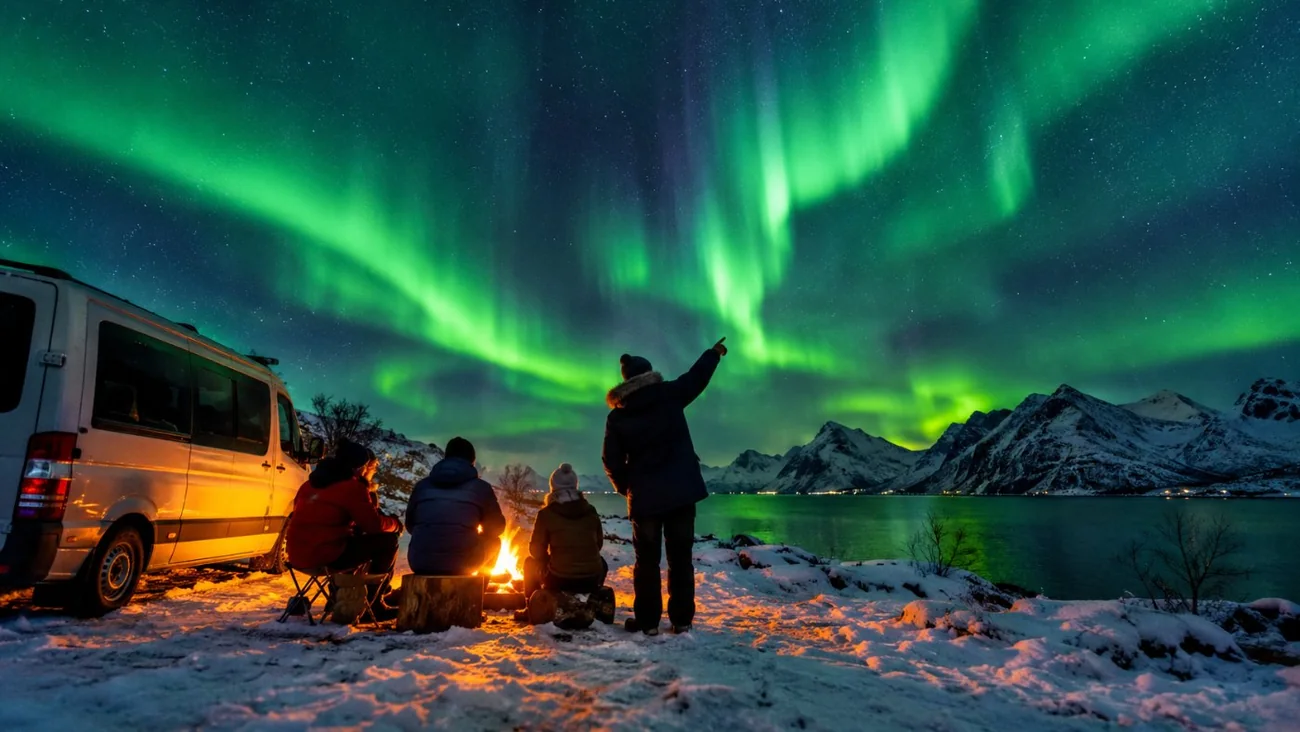
A minibus that leaves town for the clear sky, with a thermal suit and your portrait under the lights.
Book thisHow should you plan your nights this season?
Stay at least three or four nights, book a chase early in the trip, and keep a spare evening. The weather decides more than the Sun.
Coastal Tromsø catches weather off the sea, and cloud can sit over the island for days. That is the whole reason chase tours exist: a guide reads the cloud maps and drives inland, or across the border to Finland, to find a gap. Guests on the Northern Lights Safari reported a drive of about 2.5 hours to Finland on one cloudy September night, and still saw the lights.
Book your first tour for the first or second evening. If it clouds out, you still have nights left to try again. The coach tour with free repeats lets you rejoin another night if no qualifying photo is taken, and the no-limit small-group chase has no set distance limit on its long option. Every tour on this site cancels free up to 24 hours before, so locking in a date early is a low-risk move if plans change.
And be honest with yourself about the odds. Nobody can promise the aurora on a given night. Over a week, under the oval, with someone willing to drive, your chances are good. More on choosing in our guide to northern lights tours and the best time to go.

Our pick for a first night: a guide who checks the forecasts, a fire and hot chocolate at the stop, and portraits included.
Book this Tour detailsFrequently asked questions
Will the northern lights be weaker in 2026-27 than in 2024?
Big storms are less frequent after the solar maximum, but the declining phase still produces strong ones, such as the G4 storms of November 2025 and January 2026. Under the auroral oval, cloud matters more than the solar cycle.
When do northern lights tours start in Tromsø for 2026-27?
Most tours start in early September and run until the nights get too bright in early April. The aurora can be seen from late August if the sky is dark and clear.
What is the best month in the 2026-27 season?
There is no single best month. December and January have the most darkness, February and March add daylight and snow, and the weeks around new moons give the darkest skies.
Does a full moon stop you seeing the northern lights?
No. Strong displays are easy to see in moonlight. A full moon makes faint aurora harder to spot, so the week around a new moon is better for weak nights.
Ready to book
Choose your night
Free cancellation up to 24 hours before on every option here.
Northern Lights Minibus Chase with Photos
- Minibus transport, drop-off at central hotels
- Thermal suit and hot chocolate
- Bonfire while you wait for the sky
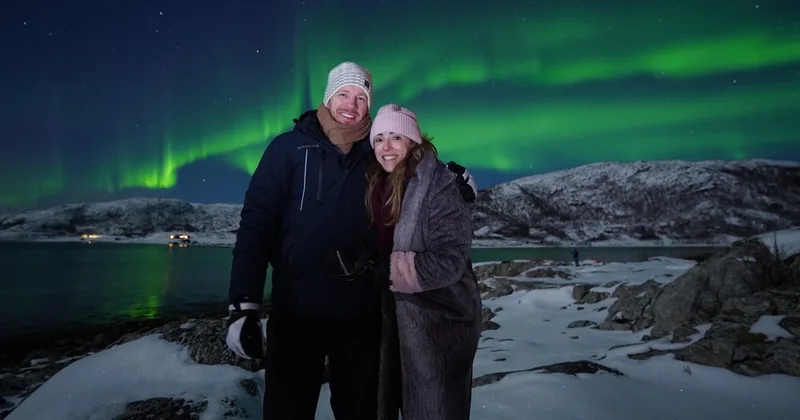
Small-Group Chase: We Drive Until We Find Them
- Small group, maximum 15 guests
- Choose 5 hours or the 6 to 8 hour unlimited chase
- Thermal suits, snacks and hot drinks
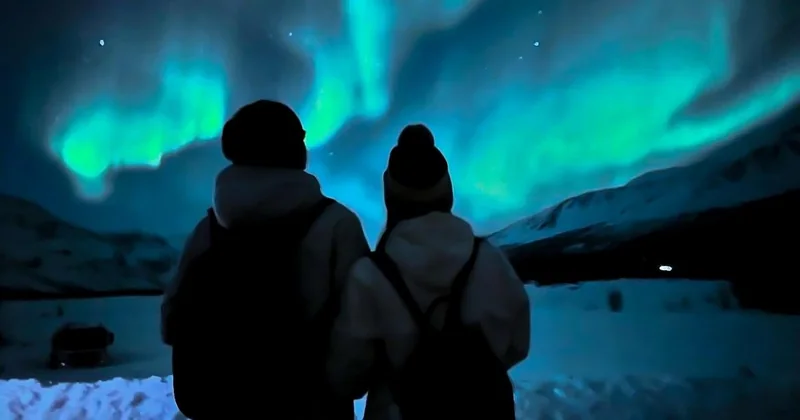
Northern Lights Bus Tour with Free Repeats
A second try is built in if the first night fails